Technical Challenge
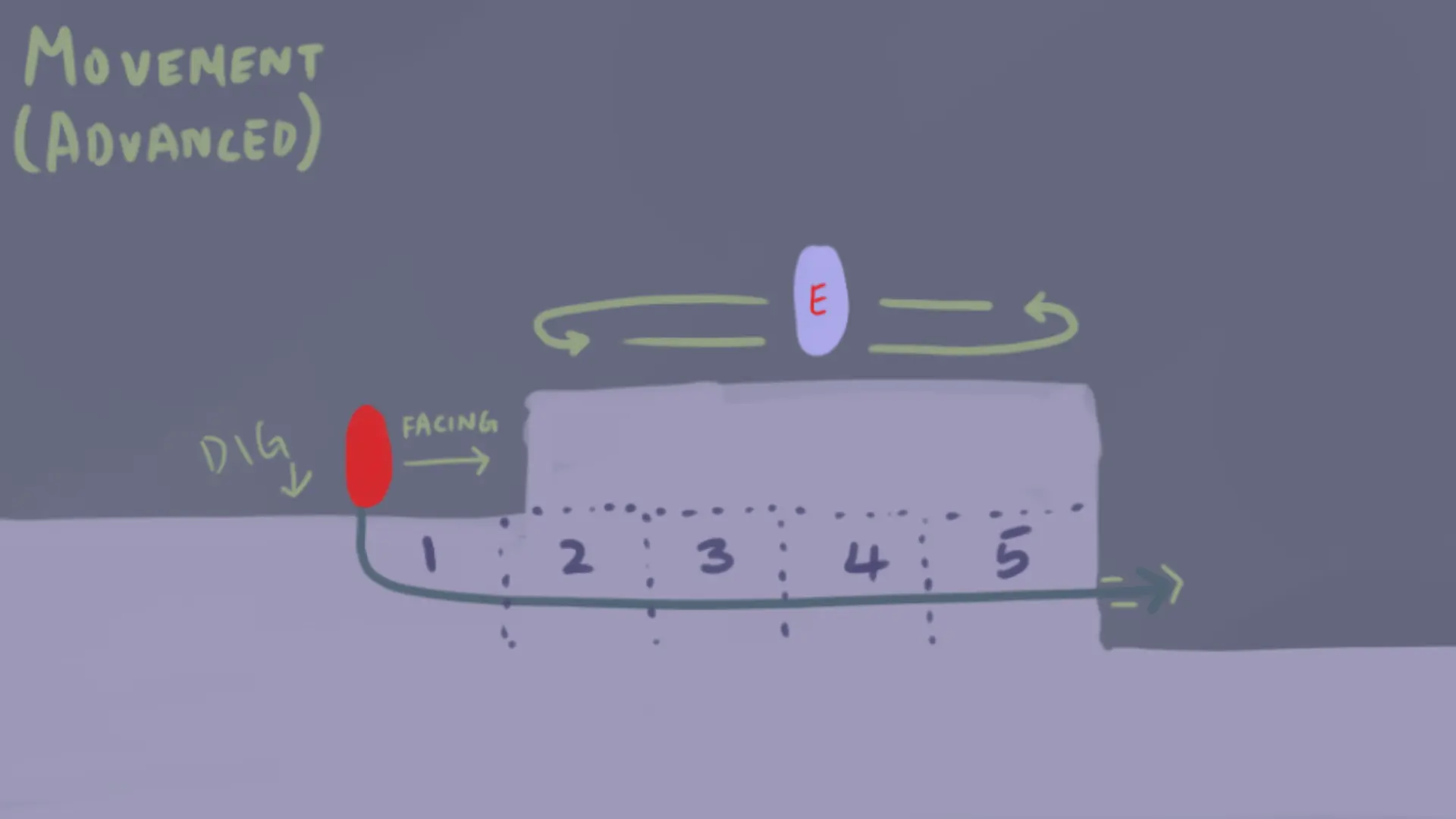
The game relied on a tile-based digging system, but the engine had:
- No tile-mapping or level authoring tools
- No support for instanced tiles
- No designer-friendly workflow for building or iterating on levels
Manually placing tiles directly in-engine would have required days or weeks per iteration, making rapid level design and playtesting impractical.
As a result, level creation became the project’s primary bottleneck.
Solution: External Level Authoring Pipeline
To unblock development, I designed and implemented a custom level-building pipeline that allowed the designers to work visually while remaining compatible with our engine’s limitations.
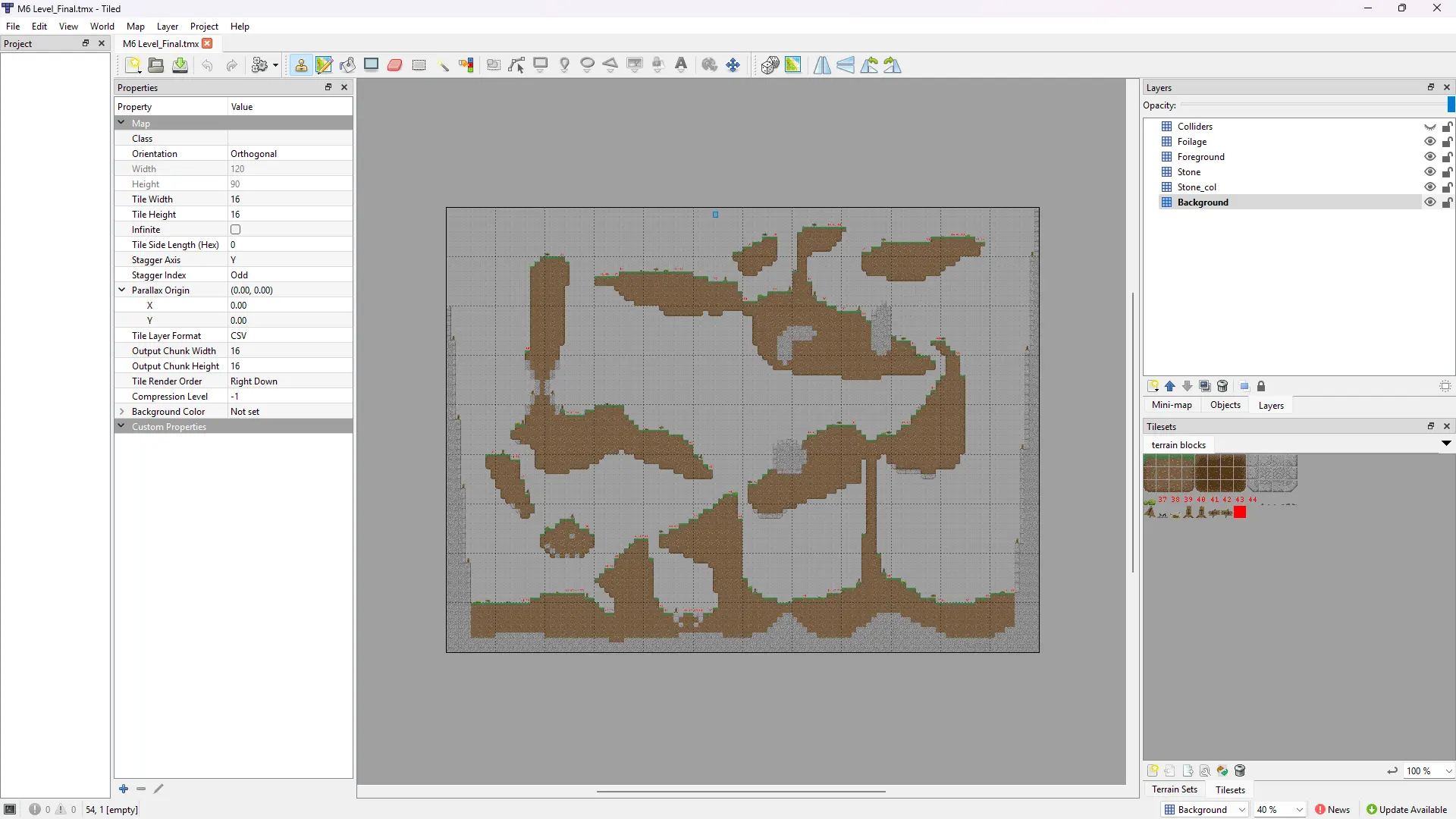
I used Tiled as an external graphical layout tool because it:
- Supported grid-based tile placement
- Allowed rapid iteration and designer-friendly visual clarity
- Was engine-agnostic and easy to parse
I wrote a custom C# conversion script that:
- Parsed Tiled’s exported data
- Structured the data to match our engine’s runtime requirements
- Converted it into a lightweight JSON format readable by the custom engine
Workflow Overview
- Levels were laid out visually in Tiled
- My C# script converted Tiled map data into engine-readable JSON
- The engine loaded and constructed levels dynamically at runtime
- Designers could iterate without touching engine code
This workflow shifted level creation from manual placement to a data-driven pipeline, dramatically reducing iteration time.
Results & Impact
- Iteration speed increased significantly, enabling more effort for game design
- Designers could focus on layout, pacing, and challenge
- The pipeline made the project feasible within the given timeline
- The engine remained lightweight, and focus could be shifted to other priorities
Although the solution was unconventional, it proved robust and effective under real production constraints.
Additional Contributions
In addition to my main role as the design lead, I contributed to:
- Rapid prototyping in Unity to define technical engine requirements
- Game programming through self-taught C++ scripting
- Sprite animation to bring static character and environment sprites to life